Friday, January 24, 2014
to focus on my favourite story
I've started of a program of reading through the Bible in a year, with a lovely group of ladies. Things to take note of seem to pop up all the time. I always seem to be jotting something down.
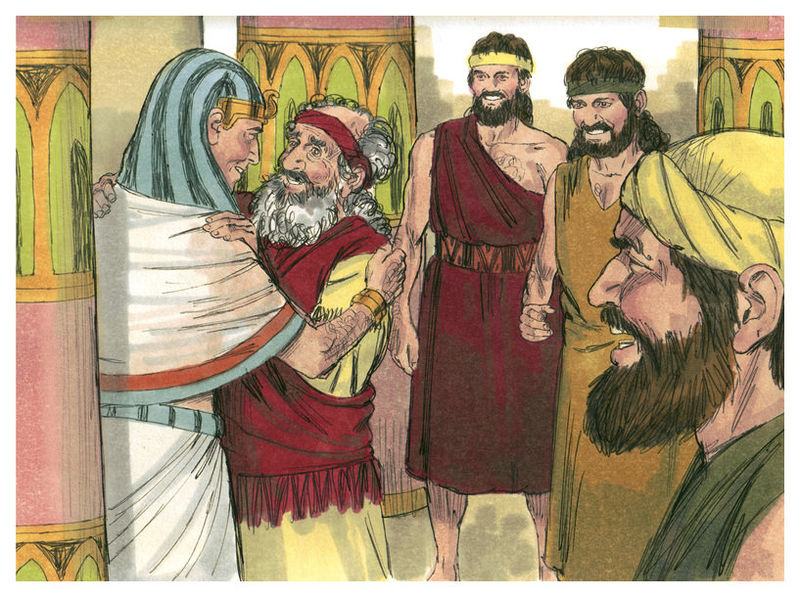
For example, consider Bible hero Jacob, as an elderly father, when he arrived in Egypt with his family, was reunited with his son, Joseph, and introduced to the Pharoah. The ruler asked how old he was, and this was Jacob's reply. 'The years of my sojourning are 130 - a short and hard life, not nearly as long as my ancestors were given.' (Genesis 47:9-10)
Our natural instinct may be to negate his opinion about the shortness of his life, but I was thinking of the bit about it being 'hard'. It's an interesting statement, coming from a man who was chosen, just like his father and grandfather, to be abundantly blessed.
He was visited by an angel and the ground upon which he lay was promised to all of his descendants for years to come. His cheating uncle didn't want to take him off the payroll, because it was obvious how abundantly his flocks and herds were being blessed while Jacob worked for him. Jacob inherited a birthright that didn't start out being his. He was clearly given precedence over his older twin brother, who didn't value the things of God as highly. He had twelve fine, strong sons and two women who loved him. (Well, at least two. Those maid servants may have been fond of him too.) At the time of his return to his childhood land, he was very wealthy, and he made peace with his brother. When we hear anything like, "You'll be like Abraham, Isaac and Jacob," we get excited, thinking that means great things will happen to us.
Yet I can understand how Jacob could make the claim he did. A blessed life doesn't mean sitting around in the lap of luxury being waited on. There may be a lot of hard work, along with some hardships at the hands of others. We each have more than one story we can tell, and Jacob's life is a prime example.
This describes the same man. He was treated as second best by his father, who favoured his brother. In fact, he was given a name which meant 'heel' and had to live with it. He had to flee his angry twin for fear of being murdered, and never saw his beloved mother again. Tricked by his scheming uncle into working hard for twice as long as he'd expected, he had to leave by stealth. He lost his most beloved wife in childbirth. His daughter was raped. His eldest son slept with his concubine and the next two went completely bonkers and massacred a whole group of people in a town. He was tricked into thinking his favourite son had been savagely mauled to death by wild animals, and grieved him for years until he found out he'd been tricked.
Doesn't this show that even a blessed life may have its share of hardships? (It's also a goldmine for people who want to talk about sowing and reaping, getting back what you give, payback, or karma, to use a more eastern term. The one who agreed to play such a deceptive trick was later the subject of some devastating tricks, first by his uncle, later by his own sons. That's the subject of another blog post I might do one day.)
For today, I'm taking the challenge to focus on my favourite of the two stories which may describe my own life. I may be the baby sister who was picked on by school bullies, later suffered several miscarriages, and have had some financial hardships. But I'm also the same person who has a good husband, three excellent kids who make me smile a lot, the time to spend writing novels, which I really enjoy, and the good fortune to live in South Australia, a safe place where we can flourish.
What are your personal stories like?
Saturday, January 11, 2014
Why people play these mind games
In the first couple of chapters of the Bible, God seems to advocate a style of parenting I've never thought highly of, the rhetorical, or leading question.
'Who told you you were naked?' Well, since He's everywhere, He would surely know.
'Did you eat from the tree I told you not to eat from?' Same as above.
'Where is Abel, your brother?' Come on! He knows the answer very well.
It's like a smug mother asking her little boy, 'Who ate the doughnuts?' when she can clearly see the chocolate icing around his mouth? I used to hate it when my parents pulled this sort of question on me. It seemed they just wanted me to fib my way into a trap so they could pat themselves on the back by calling my bluff. The parent figure comes across as gloatingly superior while the child now feels naughty and foolish, instead of just plain naughty. Why can't we just play it straight? Why make everything into a character test? It used to sadden me that God would stoop to this sort of silly mind game too.
When you do try to wriggle out of it, they are ready to pounce on you with their superior knowledge.
MUM: Who ate the doughnuts?
KID: It wasn't me.
MUM: Then go to the mirror and look at your mouth.
GOD: Where is Abel, your brother?
CAIN: How should I know? Am I my brother's keeper?
GOD: What have you done! Your brother's blood is calling to me from the ground.
Well, if that's the case, why not just say so? Surely the aim of the interrogator is either to make themselves seem smart or to make the guilty party feel even worse by showing them up as a liar too, on top of being a thief (or murderer, in Cain's case). Why do that? Surely it's no way to make people feel friendlier towards you.
Thinking long and hard about it, I've got to conclude that maybe it's good for us, to show up what is inside of us. Maybe the leading question is an effective technique when the answers come as a surprise to us. We discover ourselves doing the underhand, sneaky, sly thing when we're put on the spot. That's happened to me several times before. I'd been thinking of myself as a pretty good person, and then found myself in action telling the lies, making the excuses, running away, implicating the others. I realised that I wasn't as good as I thought I was, because I was caught red-handed. If they'd simply said, 'I know you took the doughnuts and now I'm going to punish you,' I wouldn't have realised that my natural reaction would have been to hedge around and tell lies. I might have been left feeling resentful and self-righteous. Perhaps naughty and foolish is the better option. The questions are not for their benefit but for ours, especially when it comes to God.
Later, in Deuteronomy 8:2, the Bible says, Remember how the Lord your God led you... to test you in order for you to know what was in your heart.
I do understand. This sort of test is not like an exam condition. God is not like the education department. The sort of test we're talking about is the type that shows up cracks in architecture, or traitors in war time. In the long run, it's better to be aware of our own weaknesses, than to be oblivious of them. It's better for ourselves to be shown, when we're potential traitors and don't even know it. Perhaps God tests us because we're oblivious to the mixed allegiances and motives in our hearts. When we find out, at least we're in the position to deal with them. If you're a knight, it's better to find out that your armour has chinks.
I can accept this. I like it much better than the notion that God is playing mind games with us. The questions we receive don't give God any new information about ourselves, but it may reveal a lot of new information about us to ourselves. And being armed with this new knowledge has got to be a step forward, however hard to swallow at the time.
Friday, January 3, 2014
that this is my hundredth blog post
This turns out to be my hundredth post on this blog, which neatly coincides with the first post for 2014. I've enjoyed writing this blog immensely for the past few years, and I'm looking forward to keeping it going. As I've shut down my website for financial reasons, this is now the contact site I give to anyone who wants to connect. I've enjoyed the "Just Occurred to Me" theme of mini-epiphanies. I've found that while I keep up this blog, they keep occurring, but dry up when I don't. That's a good enough reason to keep going.
One of the best things this blog has shown me is that epiphanies or serendipitous thoughts don't have to be huge to be significant. I used to make the mistake of thinking they ought to be. But so many of them are not Burning Bush or Damascus Road experiences. I'm happy enough to leave that sort for great, charismatic leaders such as Moses or Paul, because there are plenty of epiphanies for the rest of us, if only we recognise them.
Perhaps the way to attract them may simply be giving ourselves enough time to reflect and ponder. Over the years, I've read stories and memoirs by people who have gone to live in developing nations for a time. It's fascinating that many of them have reported surprise at the rush of creativity such opportunities stir up inside of them. They believed they didn't have much imagination or many fresh ideas because they were born that way, when it turns out simply living in the western world sucked a lot of it out of them. They didn't realise this until changing their location in the world.
Just waking up, turning on our computers and heading out to the shops or to work is enough to bombard our senses with all sorts of sensory stimulation from advertising to radio noise. This sort of background sense pollution is so normal to the average Joe or Jane in the twenty-first century that we're unconscious of a great deal of it. Yet it's still taking space away from the 'a-ha' moments which might flow easier if we'd let our minds and senses be a little emptier.
As well as developing nations, it was similar in the olden days. Some of our senior citizens can remember simpler, slower times. A few years ago, we visited a quiet little ghost town at the foot of South Australia's Yorke Peninsula, where there had been no doctors and the post only used to come every couple of months. That was an eye-opener for me. What a lot of room to reflect, spend time pondering great works of literature instead of speed reading (if you were lucky enough to get hold of any good books), and letting sudden ideas play out in your mind instead of smothering them when you have to rush on to the next thing.
Sometimes I get concerned about how we adulate our celebrities in the creative fields, cramming their schedules full of speaking engagements, book tours and paparazzi. Even though the world is interested to hear from them, perhaps we go about it wrong when we crowd their space and fill their days, smothering their chances to keep doing what they're good at, which is creating and thinking. Minds need clear space to start ticking with the goods, and famous people are surely no exception.
When I think about it, some great epiphanies did result from such slow, unhurried, pondering moments. Sir Isaac Newton was just taking a rest beneath an apple tree when one of the fruits fell on his head (so the story goes) and suddenly he had an epiphany about the Universal Law of Gravitation. What a momentous 'just occurred to me' moment for a fellow who was just enjoying a lazy summer day.
And Archimedes was having a soak in a warm, relaxing bath when the theory about water displacement suddenly filled his mind. If the legend we're told is completely true, I wonder if any onlookers had epiphanies of their own as he jumped out of the bath in his excitement, and went racing down the street stark naked, yelling, "Eureka!"
For 2014, I think it's a good idea to make sure to keep an environment of space and time around us to allow the rise of unexpected ideas. We don't need to move to a third world country and we certainly can't go back in time, but it's still possible to give ourselves ideal conditions sometimes. I wish you all a happy and productive 2014 and now that I've reached 100 reflections, I'm looking forward to sharing more of them on this blog.
Monday, December 30, 2013
To consider the cannonball effect
I was browsing through a library book, "A Complaint Free World" by Will Bowen. One anecdote stands out in my mind, perhaps because we are approaching the beginning of another new year. It's about a house painter named Mike who had an idea to dip a standard baseball in leftover paint at the end of each day in his garage, just out of idle curiosity to see how big it would get. The result surprised even him.
Will Bowen and his daughter were invited to come and see it after he had been doing the daily dip for several years. They found a massive thing, the size of a cannon ball hanging from steel girders. He asked them if they'd like to apply that day's coat of paint, and it took them 15 minutes to get it evenly covered. What amazed them all was the fact that each individual coat of paint was about the width of a hair. Visible proof that lots of small actions, if persisted in, result in something formidably huge.
Bowen took it as an analogy for his complaint free world. Each individual decision to stay cheerful and not make an issue of annoyances may result in a transformed personality which automatically leans toward the optimistic option. I started to reflect that the principle applies to absolutely anything we can think of.
We all know that individually, one yummy Lindor chocolate ball or Cadbury Freddo frog doesn't contain enough calories to put on much weight. If you indulge in them a lot, though, they become like those coats of paint, and your waistline ends up much thicker. One jog up a steep mountain path may result in no difference on the scales, which contestants on "The Biggest Loser" have discovered many times, but making a habit of it can get that flab moving. Brain science has shown that one thought, repeated over again several times, results in an entrenched attitude that wears a pathway, similar to the ones we see worn across the paddocks near our house, by lots of pedestrians taking short cuts to the wetlands.
Each late December I hear plenty of negative comments about making new year's resolutions. "We might as well not even bother. By February, we're back to our old habits, or April at the latest." No, that's a gloomy attitude masquerading as realistic. By February, the baseball hasn't grown very big at all, and it's easy to look at the thinness of each individual coat of paint. It's right about then that we could benefit from reminding ourselves about the huge, impressive cannonball we could create, if only we persevere. I like new year's resolutions and begin a couple every January. I'd encourage everyone to do the same, if there's something in your life you wouldn't mind reversing or changing.
Even if you decide, "I need to accept myself more, and not get into the self-help trap of thinking there's always something wrong with me that I need to change," that's still a resolution, if you're not used to thinking that way. In fact, that may well be one of mine.
Mother Teresa vividly showed this principle with the poor in Calcutta, that thousands of small gestures, repeated over and over, may produce a wonderfully productive and difference-making life. It doesn't have to be that grandiose or self-sacrificing. I'd extend the analogy to blogs like this one. Although our numbers of followers may change and drop-off over the years, each post may result in a thick volume of awesome material which our descendants will love. In this one's case, I hope the number of small, serendipitous thoughts that just occur to me may morph into something bigger with the potential to amuse people who want a bit of simple inspiration.
I wish everyone who may read this a hopeful, healthy and productive 2014.
Will Bowen and his daughter were invited to come and see it after he had been doing the daily dip for several years. They found a massive thing, the size of a cannon ball hanging from steel girders. He asked them if they'd like to apply that day's coat of paint, and it took them 15 minutes to get it evenly covered. What amazed them all was the fact that each individual coat of paint was about the width of a hair. Visible proof that lots of small actions, if persisted in, result in something formidably huge.
Bowen took it as an analogy for his complaint free world. Each individual decision to stay cheerful and not make an issue of annoyances may result in a transformed personality which automatically leans toward the optimistic option. I started to reflect that the principle applies to absolutely anything we can think of.
We all know that individually, one yummy Lindor chocolate ball or Cadbury Freddo frog doesn't contain enough calories to put on much weight. If you indulge in them a lot, though, they become like those coats of paint, and your waistline ends up much thicker. One jog up a steep mountain path may result in no difference on the scales, which contestants on "The Biggest Loser" have discovered many times, but making a habit of it can get that flab moving. Brain science has shown that one thought, repeated over again several times, results in an entrenched attitude that wears a pathway, similar to the ones we see worn across the paddocks near our house, by lots of pedestrians taking short cuts to the wetlands.
Each late December I hear plenty of negative comments about making new year's resolutions. "We might as well not even bother. By February, we're back to our old habits, or April at the latest." No, that's a gloomy attitude masquerading as realistic. By February, the baseball hasn't grown very big at all, and it's easy to look at the thinness of each individual coat of paint. It's right about then that we could benefit from reminding ourselves about the huge, impressive cannonball we could create, if only we persevere. I like new year's resolutions and begin a couple every January. I'd encourage everyone to do the same, if there's something in your life you wouldn't mind reversing or changing.
Even if you decide, "I need to accept myself more, and not get into the self-help trap of thinking there's always something wrong with me that I need to change," that's still a resolution, if you're not used to thinking that way. In fact, that may well be one of mine.
Mother Teresa vividly showed this principle with the poor in Calcutta, that thousands of small gestures, repeated over and over, may produce a wonderfully productive and difference-making life. It doesn't have to be that grandiose or self-sacrificing. I'd extend the analogy to blogs like this one. Although our numbers of followers may change and drop-off over the years, each post may result in a thick volume of awesome material which our descendants will love. In this one's case, I hope the number of small, serendipitous thoughts that just occur to me may morph into something bigger with the potential to amuse people who want a bit of simple inspiration.
I wish everyone who may read this a hopeful, healthy and productive 2014.
Monday, December 9, 2013
that we choose our own version of success
I've been reading a bit about this man and his philosophy. It's Henry David Thoreau and he became one of the world's most famous non-conformists.
It seems he'd tried to live as others did. In his twenties, he'd taken on the jobs of teacher, surveyer, gardener, farmer, house-painter, carpenter, mason, day-labourer, pencil-maker and glass-paper maker. He found aspects of each of them disappointing and decided to no longer be included among the 'mass of men who lead lives of quiet desperation' as he put it.
In 1845, aged 27, Thoreau set off to build himself a rough, basic house on the shores of Walden Pond. He intended to work for just six weeks of each year (probably helping farmers get their crops in or something like that) and figured out how to live off just 27c per week for the rest of the year. During the other 46 weeks of the year, he reflected on nature, read, wrote in his journal and walked. Sounds pretty good to me.
He had one bed, a table, a desk, 3 chairs, a small mirror and some cooking utensils in his one-room house. Thoreau studiously avoided anything 'the world' would consider successful. He dodged all forms of work to the greatest extent possible, which turned out to be a lot.
"Joy and sorrow, success and failure, grandeur and meanness do not mean for me what they do for my neighbours," he wrote. Just to make his outlook crystal clear, he added, "If a man has spent all his days about some business by which he's grown rich, has got much money, many houses, barns and woodlots, then his life would have been a failure, I think. Normal society man has no interest that can tempt me. Not one." Ignoring his neighbours and choosing to 'march to the beat of his own drum' came easily to him.
His contemporaries only scoffed at him, including intellectuals like Ralph Waldo Emerson and Bronson Alcott, the father of Louisa May Alcott. But as one of my books says, "to a true eccentric like Thoreau, earning the disdain of others, or at least puzzling them, is a sign of success." As for his own personal job description, he called himself the self-appointed and unpaid inspector of snowstorms and rainstorms.
Here is one of his most famous quotes, which I'm sure we've all come across many times. "If one advances confidently in the direction of his dreams, and endeavours to live the life he has imagined, he will meet with a success unexpected in common hours." We see this splashed over cards and souvenir merchandise in gift shops. It's in the offices of high-flyers on desk calendars and wall hangings. All sorts of business people and VIPs quote it. It's become one of the mantras of wealth creation teachers. How ironic, to think that it came from a man who didn't care a fig for all that, and in fact, stood for the opposite of what they stand for and wasn't afraid to say it.
And how funny to think that so many twenty-first century ambitious go-getters quote it glibly, along with the one about marching to the beat of their own drum, without knowing the background of their creator. They may or may not recognise the name of Henry David Thoreau, but I'm sure they claim that his words resonate with them. I wonder what his reaction would be to the irony that they have latched so fervently onto his sayings. No less, is the irony that tourists from all over the world visit his little house on the shore of Walden Pond to this very day, but possibly shun the fellow down the road who is really living in the spirit of Thoreau, the one who lives in a little shack, clothing himself from Good Will shops, heating his baked beans over a little campfire each night and reading his books by torchlight.
I have to say I find his attitude refreshing. Henry David was the real deal, not part of a group who dress the same, eat the same, surreptitiously study the way people such as themselves are 'meant' to think and wear their supposed non-conformity like badges. He wasn't a burden on the tax payer, because he genuinely earned his 27c per week, and Centrelink payments weren't even an option. This gives us exciting freedom and potential, when it comes to defining what the 'success' in his quote may mean to us. I applaud Thoreau for deciding on his own values and sticking to them without being swayed by what people were saying. The lives of people such as him remind me that, hey, even if I don't look successful, by what criteria am I making the judgment? When I start feeling like a flop, I can remember Thoreau, and he reminds me that I've moved the measuring stick by which I determine my values. That's right, I'm not going by job description, bank account total or academic letters after my name. My personal values are time spent with family, laughing at their jokes, listening to them, reading good books, writing some stuff, noticing things when I go for walks, and encouraging my kids to focus on their own values with the tool of homeschooling. I find it easier to think of myself as successful with these things as my gauge.
I've never been to America, but if I ever do, I'd like to visit that little house, and I've got the book "Walden" on my kindle to dip into sometimes when I feel reflective.
Friday, November 8, 2013
We brush past an amazing hidden world
We live in a commercial, western world which encourages us to put ourselves forward and get attention. This is understandable when you consider that businesses need customers so that employees can be paid, so that families can comfortably earn a wage they need to survive. But just because that's the way we've been brought up to think things have to be, I've been wondering if it's necessarily the way the world was designed to operate.
A fair bit of photography has been taking place around our house. When we were up in Cairns, my nephew and my daughter both bought themselves good quality Nikon cameras. We've never owned anything with such a decent zoom lens before, and I've been enjoying the close-ups.
On the train back from Kuranda to Cairns, we were looking down at the spectacular Barron Falls and noticed a walking group standing beside the edge. Emma decided to zoom in on them with her camera to get a closer look at what they were doing, and to her shock, one fellow unzipped his fly and started to relieve himself over the edge of the waterfall. Her eyes were popping out of her head. "It's the guy in the yellow t-shirt!" Even though he was apparently still flowing, they all looked like ants to me. Being able to use that camera to pry into things not easily seen with the human eye has its moments of surprise.
On that same ride, a plain looking little bird on a distant sign post turned out to be a pretty kingfisher with delicate shades of blue. We'd never have realised it. Since we've been home in Adelaide, I've continued to be surprised at fine detail we usually miss. The shaggy wings of a close-up little moth are just like Mr Snuffleupagus from Sesame Street, or some sort of fringed garment. A tiny bug on the side of the guinea pig hutch turns out to have amazing detail in each of his wings, finer than any pencil point could draw. It fills me with awe at how delicately and wonderfully crafted the details of creation are, yet we so often breeze past without noticing.
Funnily enough, it's helped me put my writing in perspective. The same probably goes for you, whatever it is you do. If God gets his fine craftsmanship and breath-taking detail brushed past every day, then humans doing creative things don't have to worry when the same thing happens to us. Creativity doesn't have to be admired. That's not its main purpose, whatever we've been brainwashed to think. It's there for its own sake, and if anyone does get a bit of a 'wow' when they get a glimpse into secret places, that's a bonus.
For one of his recent birthdays, I took my youngest son and his sister down to the city to visit the museum. There had been school excursions getting hands-on lectures from a group of scientists, and we were lucky enough to arrive at the tail end of a presentation. As the school kids were filing out, one of the demonstrators was at a loose end. He invited my kids to come over and pick tiny particles out of a mound of dirt with tweezers. It turned out to contain lots of hidden secrets.
As Emma or Blake pulled up anything a little bigger than a normal speck of dust, he'd magnify it for them and say something like, "That is the back knee joint of a tiny gnat," or "That's the shoulder socket of an ancient grasshopper," or, "That's part of a marsupial's toe nail." They had him all to themselves for about half an hour.
I'm reminded of my characters, Brooke and Aidan, in "The Greenfield Legacy", the novel I worked on with three other authors. In one of my sections, Brooke tells Aidan about seeing a flower blooming on top of a lonely hill where people rarely go, and that she found herself wondering what purpose such extravagance could serve, to which he replies, "Well, you saw it."
The world is extravagant like that. On our holiday, Blake and I went on a glass bottom boat. It's a vividly colourful, vibrant world down there, but it's usually hidden from human view. Clown fish and turtles were just doing their usual thing, not knowing that several people were getting a peep into their secret world. I'm also reminded of pregnancy ultrasounds, when babies are just wriggling around, doing whatever it is they do at that stage of their lives, oblivious to the fact that they are being observed, and people are saying, "Look at his dear little fingers."
As I said, I don't necessarily think the world was designed for people to be thrusting themselves into the limelight, but we've felt we had to make it that way. I'll keep encouraging the kids to take photos, watching nature documentaries and work on their own creatives pursuits as I do the same. As it is such an incredibly detailed world, it's a shame to live our lives not delving into it and finding out more.
All photos were taken by Emma with her new camera.
Friday, October 18, 2013
That we may have Mount Everest syndrome
I was studying this huge mountain with my younger son. It's so impressive, being the world's tallest, at 8848 metres high. Apparently it still grows by about 0.25 inches each year, even at 60 million years old. It was first identified by a British survey team lead by George Everest in 1841, but not until 1953 did anyone manage to reach the summit. It was achieved by Sir Edmund Hillary from New Zealand and Tenzing Norgay, a Sherpa guide, making them instantly famous.
I applaud Junko Tabei, the first female to reach the top, not to mention Miura Yiuchiro, the oldest person to reach the top, aged 80, just last year in May 2013. I'm about half that age and just hiking the hills around home gets me huffing and puffing. Flinders Ranges' Mount Remarkable was almost too much for me, at 960 metres. Over time, thousands of people have tried to reach the top of Everest, and many nameless folk have died making the attempt, in the name of thrill seeking or notoriety. My nephew's karate sensei spent some of these last holidays climbing part of it. Even though he has a fitness level of an Olympic athlete, he didn't even attempt to make it all the way up. He told them all stories about the thinness of the atmosphere, and the many stops they would make just to get their breath back and conquer that altitude sickness. Something about a challenge of that magnitude appeals to the adventurous streak that lies buried in all of us, some deeper than others.
Yet it would seem that, from space, it is a different story. From a vantage point of that magnitude, Mount Everest is merely part and parcel of the crust of the earth. In fact, it was even surprisingly difficult to single out. Russian cosmonaut, Valentin Lebedev, said, "How many people dream of conquering Everest so they can look down from it, yet for us up above, it was difficult to locate."
This God's eye perspective, as it were, instantly made me feel peaceful, although I had to think about it to figure out why. Finally, I got it. It's all to do with the fact that it is we humans who label things with significance and importance, by deeming them big or impressive from our vantage point. As it's not at all the same for God, we needn't worry about buying into all that.
We make Everests out of many things. Humans are those who spread the illusion that some lines of work are way more illustrious than others, and that achieving celebrity-hood or stardom in some area must be the pinnacle. I now like to think that from a lofty enough heavenly perspective, all the good we do just becomes part of the earth's fabric. That means we don't really have to bust our boilers, burst our blood vessels and strain our Type A personalities to impress the people walking around down here, who share our limited focus.
I imagine some member of the angelic host from way above whose vantage point is more like that of Lebedev and his fellow astronauts, saying, "What Mother Teresa and Billy Graham have done is wonderful, but it's just part of the fabric of what love-driven servants are doing everywhere. Look at Jane Doe, looking after her sick mother and working hard as a single parent to support her son through college. Or Joe Blogs the bus driver, sticking to road rules and greeting all his passengers cheerfully, day after day. It's all one and the same, and we love it."
If we've ever been afraid of never hearing, "Well done, good and faithful servant," thinking our work is too little or measly to justify the space we take, it might be time to get over our Mount Everest syndrome. When I finish writing this blog post, I'm going to go and clean my kitchen, take my young son for a night walk, then before long I'll be hopping in the car to pick my daughter up from youth group, about 20 minutes drive away. I'll have to remind myself that it's all adding to crust of love-driven deeds that makes the earth a great place to live, even if it's not Mount Everest.
Subscribe to:
Posts (Atom)


